Love that, if OnvoySinch can redeem themselves then anyone can! 
Tim, sorry to interfere in the conversation but I do wish to share my perspective. I think that it might be a sentiment shared by many individuals on this great forum.
I agree with you that one of the main root causes of the problem is the poor regulation of telcos in the US. If we take a look at several EU nations, especially in northern part of Europe, it is fairly evident that their stricter regulations and robust KYC process mandates make it very challenging for scammers to harass their public. For example, any person trying to obtain a set of VOIP numbers in Germany must present a valid ID and credit card in-person to the carrier. The latter then must store the info in the database accessible by LEOs and government regulators. In Ireland, no foreign entity can call Irish phones or spoof numbers to appear Irish, as I recall.
The other root cause appear in the timidness of the US Federal Government when it comes to holding domestic and foreign telcos accountable. There are all sorts of goofy protections of telcos turning a blind eye to illicit robocalls. One of them is CPNI and Common Carrier Provision. If the US legislators were to take those away or at least curb them to some extent, then we would be able to sue carrier in the court of law. Currently, it is unfortunately nearly impossible. I had tried many times and it never got too far. Had the US revised its laws to allow for private lawsuits, it would be game over! Imagine how much money TCPA attorneys and private citizens like us could generate off negligent or malicious carriers and their infamous resellers!
The third factor I would like to mention is the governmental and societal shyness or negligence when it comes to holding the key offending nations accountable. Let’s be honest, most scams do come from India, Pakistan, Philippines and a handful of others. Most of the aforementioned nations are quite impoverished and lack political will or interest in enforcing anti-fraud laws. Had we managed to create the NATO-US-ANZAC anti-scam international coalition, we would have made them more accountable within months, if not weeks. For example, most of us do not have families in either of these countries, so what exact business do their nationals have calling us? Has anyone ever asked this question? I most certainly would not be upset if the authorities were to ban any foreign nationals or entities from acquiring or reselling US phone numbers or giving them access to our phone network.
I am not trying to challenge you, by any means. I just wished to contribute to the conversation in a civil manner.
Also, I think the more costly and difficult we, the civil society, make it for the telecom to enable scammers and spammers or turn a blind eye to robocalls, the better off we will be. I love sending sternly-worded legal demands to telcos, filing complaints about them and filing lawsuits against illegal telemarketers. Interestingly, I’ve noticed a tremendous reduction in the number of robocalls harassing me lately. I think the legal aspect of it may have something to do with it (I sure do not make it easy for the spammers or telcos to allow such harassment against me)

@MajorLeeAwesome @Sol @Jhawk @Tillianne @FantasticsSnow @MehNamesJeff @T-Rex @CatMan @Freefall @SouthernCulture_x
Let’s be even more honest. Of all the countries mentioned, India is, by leaps and bounds, the worst for phone scams and it’s not even close. According to the US government “around 90% of phone scams come from India”.
According to Jim Browning (who has been monitoring these calls for years) “It’s more like 96%”
As far as being impoverished, the poverty rate in India is:
“In 2024, India’s poverty rate has fallen below 5%, with extreme poverty nearly eradicated, according to SBI’s research. Poverty dropped to 4.86% and urban poverty to 4.09%. The National Sample Survey Office (NSSO) Consumption Expenditure Survey estimates that India’s poverty rate has fallen to a decrease from 61.8% in 2011-12.”
(Yet at the same time, phone scams have gone up about 400%)
In 2023, the poverty rate in the United States was 11.1%, that’s nearly three times the poverty rate of India!
In 2024, according to congress.gov, the US poverty rate soared to 12.9%
Agreed! Some more honest perspective to share: In 2024, India accounted for 1.8% of total U.S. trade. This is literally almost nothing for us, if we were to impose severe sanctions on them and drop them completely as a trade partner. India’s trade surplus with the U.S. in 2024 was $45.7 billion, which means that they basically purchase little to none of the US goods and services. They however hugely benefit from the American consumers. And yet… they also appear to turn a blind eye to scams targeting often the most vulnerable and impoverished US persons. This is truly a shame and is outrageous on so many levels! It is akin to a dog biting the hand that feeds it…
Oh, and let’s not forget all the help we provide to them, whether it is vaccines, medications or other sorts of aid. The US did a lot for them during Covid, for example.

Not to mention that in India, any proceeds from foreign nations is tax exempt. This means that of the 10s of billions of dollars that scammers steal, not one dime goes to help the citizens of India; it goes right in the pockets of the scammers.
Furthermore, Indian “consultants” and “tech giants” tend to severely abuse the US visa and immigration system. By doing so, they significantly limit the career and educational opportunities for law-abiding upstanding foreign nationals who want to contribute to our society positively. Here is just one of the examples below. These “tech firms” steal the opportunities from the American people and effectively avoid taxes. Also, I am sure that many of you were bothered and harassed by the so-called “Indian recruiting firms” at some point in your lives. I definitely was.
KYC remains a major issue in the U.S., largely unenforced by telecom providers. While law enforcement should hold scammers accountable, most operate overseas, and international enforcement is slowed by red tape. Unlike Europe, the U.S. functions more like 50 separate countries. Each state has its own laws, many of which are inadequate for regulating telecoms. Changing laws in one state doesn’t guarantee adoption in others.
My perspective is actually based on direct work in telecom investigations and collaboration with regulatory bodies like SOMOS, not personal opinion (I gave up on that a long time ago when the actual data said otherwise). Telecoms can shut down scam numbers easily. The problem is getting them to act. I’ve witnessed this firsthand.
Regulation in the U.S. is also more feasible than trying to hold foreign nations accountable. My team has helped push telecoms to change policies and take fraud more seriously. If better tools existed for reporting scams, the problem wouldn’t be this widespread.
Using NATO is an overreach. Scammers exploit weak U.S. state-level enforcement, not international conflict. Some states let scammers open shell companies without verification. That’s a domestic issue, not a military one.
Lastly, many U.S. companies (T-Mobile, Amazon) outsource work to countries like India, a key global market now. So the idea that people overseas shouldn’t have U.S. numbers doesn’t really hold anymore due to those same companies outsourcing cheap labor, even though you are correct in that assumption.
Here’s an example of some of the work the team that I work with has done: https://commsrisk.com/scam-hunters-observe-rising-use-of-t-mobile-us-prepaid-sims-by-criminals/
As difficult as it is, we follow the data, even if we don’t like what it tells us.
You know, it’s funny that you mention robocalls as so many telecoms still think that all scams are robocall related. It’s unbelievable that many telecoms are still unware of the refund, pop up and scam text messages about fake invoices being sent to consumers, while only focusing on robocalls, which make up only a small portion of scams from overseas.
It’s infuriating to know that many telecoms are still unaware that many scams are designed to have the consumer call the scammer, not the other way around. Commio for example, did away with their email address and instead made a “report robo calls” form - that does not do a damn thing about a pop up scam or a refund scam, since the form wasn’t designed to report such scams to them.
They and many others are 6 steps behind in the fight against scams.
Thanks for your responses, Tim. I think that we are largely on the same page, especially regarding the inaction and lack of accountability in the telecom world. We do need better KYC, stricter regulations and sterner enforcement, that’s for sure!
No problem, man. We all want the same thing. We want these scams to stop. I for one am always in favor of sharing intel, provided that it doesn’t aid the scammers of course. 
Oh, and I do read Commsrisk daily. You guys did a tremendous job with pointing out the issue with T-Mobile’s prepaid SIM cards. I read about it a couple of weeks ago and praised your group. Eric Priezkalns is a highly intelligent and helpful person. I wish we had more guys like him!

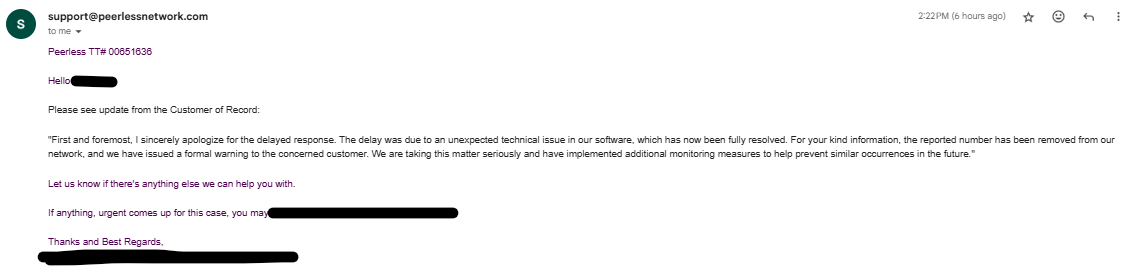
This number has been shut down by BCMOne: (855) 730-9165